Date: 28.01.2026
Turning freight procurement from email chaos into a structured, automated workflow
If you have ever managed transportation at bigger volumes, you know the pattern.
A shipment request comes in, details get copied around, and carriers get pinged one by one. Multiple replies start coming in, and offers are often higher at first, because you don't really have time to negotiate. So, you choose the one your gut feeling says should be right.
And realistically, you probably won't reply to every carrier with: “Sorry, this time your price was slightly higher.”
The real problem: time leaks in transport management
Most transport teams don't lose time because they don't know what to do. They lose time because the process is fragmented, and there simply isn't enough time to go into detail.
Typical problems look like this:
Shipment info lives in multiple places (ERP, emails, spreadsheets)
Capacity checks and price discovery happen in parallel conversations
Negotiation is unstructured (and hard to compare objectively)
Documentation gets scattered across inboxes and folders
This is exactly the kind of work that doesn't scale with “more effort.” It scales with better systems and tools.
A Monday morning scenario
Imagine it's Monday morning. You have 8-12 shipments to cover, a couple of them urgent, and at least one with special requirements.
You send out the same load details to your carrier list, and within an hour you get a mix of replies:
some prices are high “just in case”
some carriers ask follow-up questions
a few don't respond at all
You know you should negotiate, but you also know that every extra back-and-forth costs time, and time is exactly what you don't have. So, you pick the offer that feels safest, confirm it, and move on to the next fire.
The hidden cost isn't only the freight rate
The hidden cost isn't only the freight rate.
It's:
lost options, because you didn't have time to compare properly
inconsistency, because decisions depend on who answered first
lack of traceability, because the reasoning is scattered across emails and calls
The longer procurement takes, the more expensive and riskier the outcome tends to become, not because people are bad at their job, but because the workflow is not designed for speed and clarity.
How does a structured workflow look like?
In practice, “structured” doesn't mean complicated. It means you stop reinventing the same process for every single shipment.
A good workflow usually has a few repeatable steps.
1) Shipment data in one place
Load details shouldn't live across ERP notes, email threads, and spreadsheets. If the data is centralized, you remove the first source of mistakes: copying and re-copying information.
2) Pre-defined carrier pools and simple rules
Instead of manually deciding who to ask every time, you define carrier groups by lanes, equipment types, service levels, or priorities. Then the right group is engaged automatically, based on the shipment.
3) One structured request instead of multiple parallel conversations
Rather than calling and emailing one by one, you run a single structured request for quote to the relevant carrier pool. Everyone gets the same information, and you can compare offers objectively.
4) Negotiation becomes a process, not a mood
This is where most teams lose money, not because they don't know negotiation matters, but because they don't have time to do it consistently.
With a structured loop and optionally automation/AI in the middle, negotiation stops being “if I have time” and becomes part of the workflow.
5) Decision trail + documents stay attached to the shipment
Even if you still make the final call based on experience, you want the reasoning, offers, confirmations, and documents to stay connected to the shipment. That's what makes the process measurable and improvable.
The point isn't to remove people from the process
The point isn't to remove people from the process. It's to remove the manual ping-pong that forces people into rushed decisions and makes outcomes dependent on who happened to reply first.
What changes when the workflow becomes structured
Once the basics are in place, you start seeing improvements in a few very practical areas:
Time to confirmation goes down. Less back-and-forth means fewer “waiting gaps” between steps.
You get more comparable offers. When everyone receives the same request in the same format, it's easier to compare price, lead time, conditions, and service level.
Negotiation becomes consistent. Not every load needs heavy negotiation, but the option is always there, and it's not dependent on whether someone has 15 spare minutes.
Better carrier communication. Even a simple structured process reduces “no- replies” and makes it easier to close the loop with carriers.
Who benefits most from this approach
This matters most when transport is a daily operation, not an occasional task. Especially if you have:
recurring lanes and a trusted carrier pool
a lean team managing a high number of shipments
seasonal peaks where manual work explodes
pressure to reduce cost without sacrificing service level
Start small
The easiest mistake is trying to redesign everything at once. A better approach is to take one slice of your operation and make it repeatable.
Pick 1–2 high-volume lanes (or one shipment type)
Define your trusted carrier pool for those lanes
Standardize the RFQ information (what carriers always need to see)
Add simple routing rules (lane → carrier group → request)
Measure two things: time-to-confirm and price spread from first offers to final accepted
Once you can see those numbers, it becomes obvious where structure and automation pay off.
Bringing it back to LoadGate
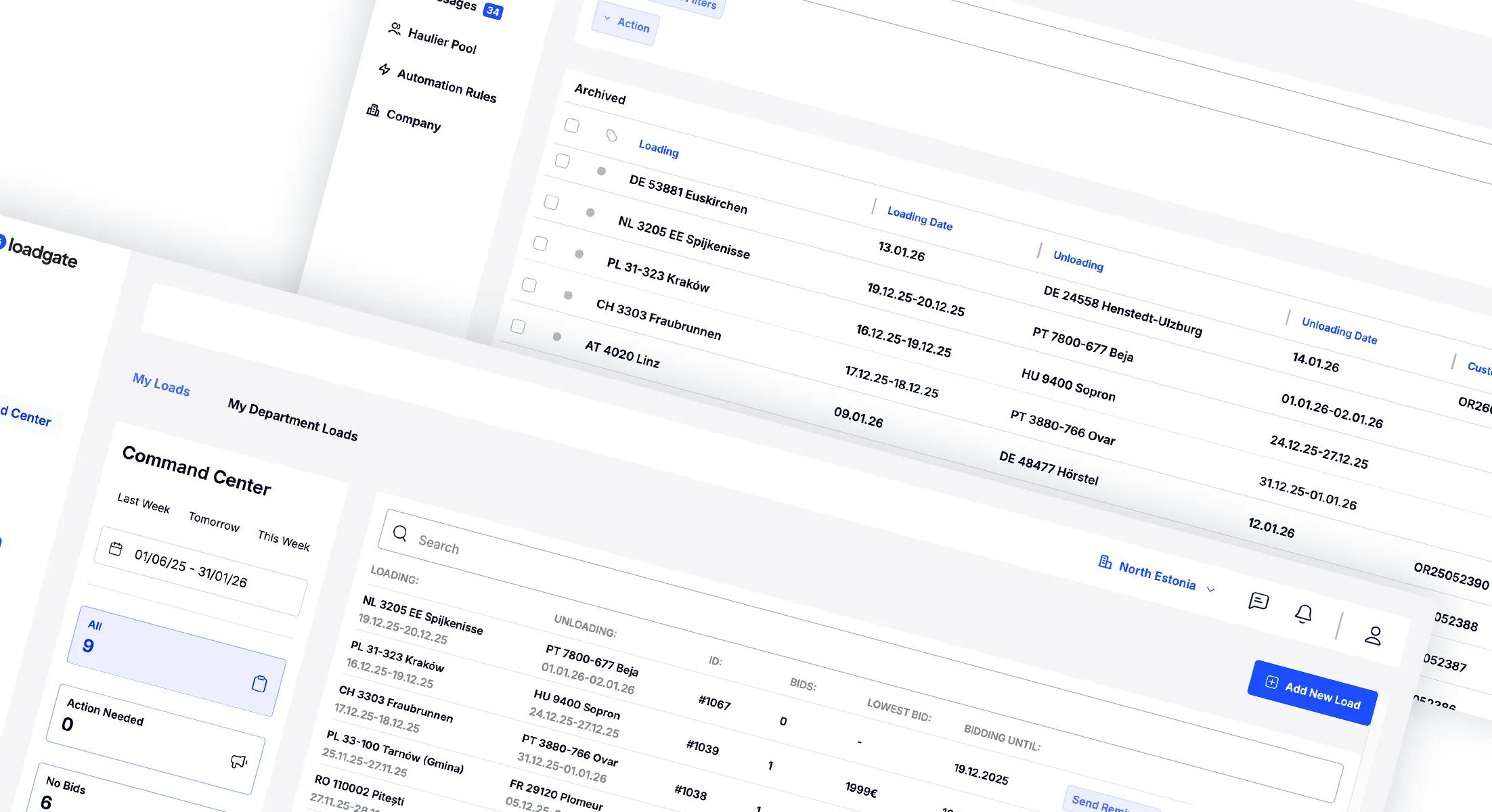
This is exactly the logic behind how LoadGate approaches freight procurement: keep your trusted carrier pool, remove the manual chasing, and make the process repeatable, from sending out a request to comparing bids and keeping the decision trail attached to the shipment.
If you're curious, we are happy to share what this looks like in real workflows and what teams usually automate first.